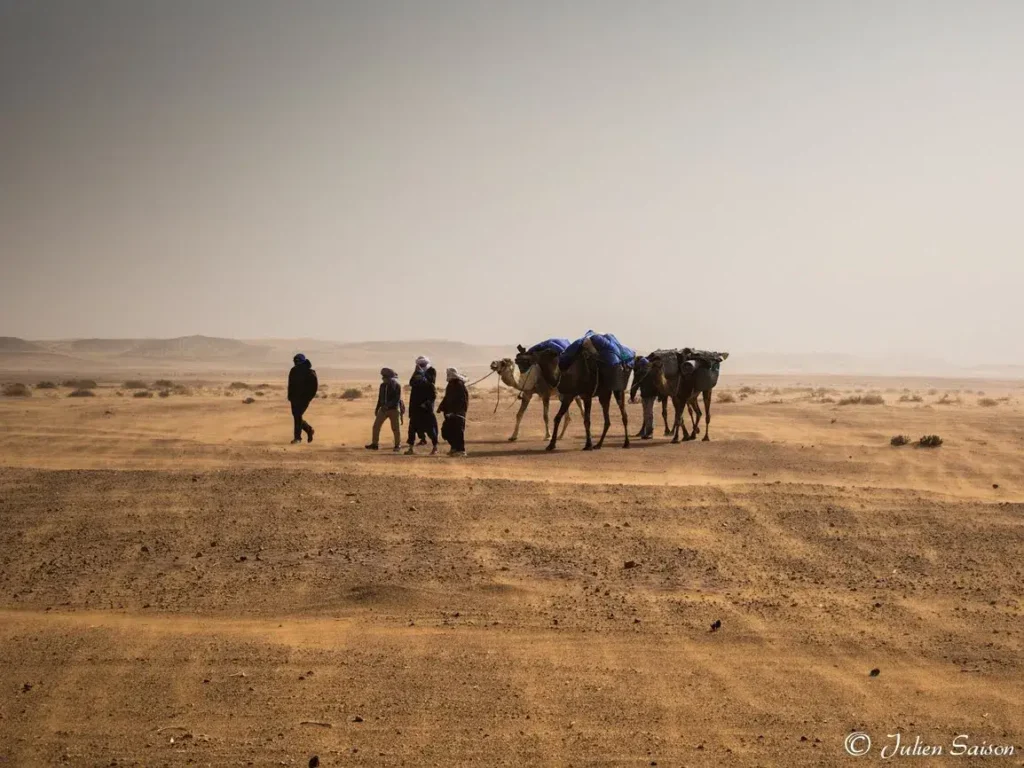
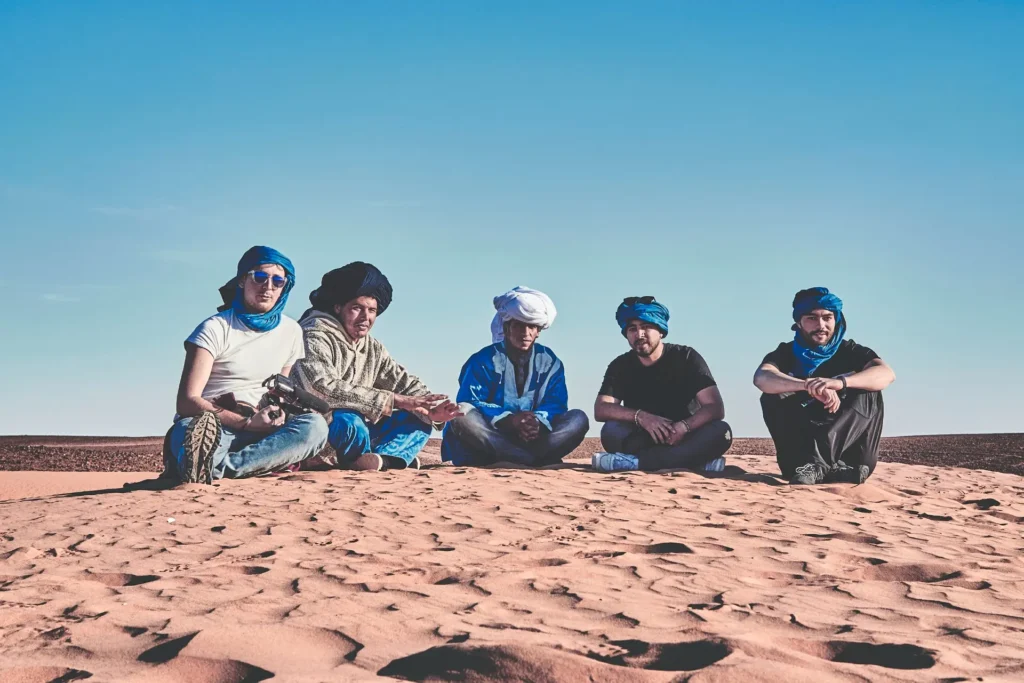
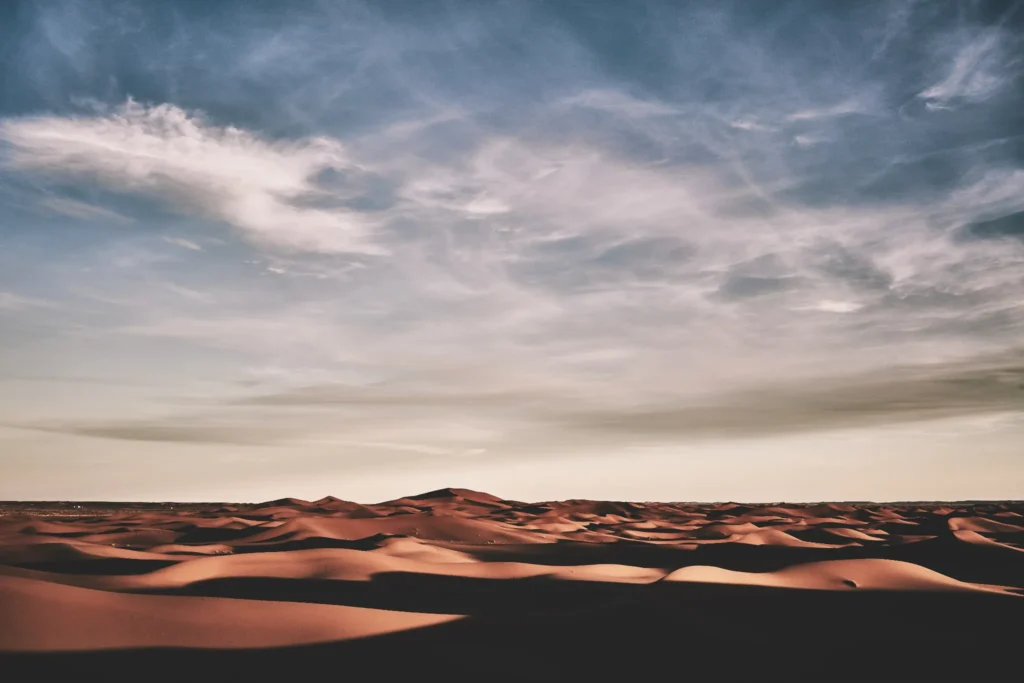
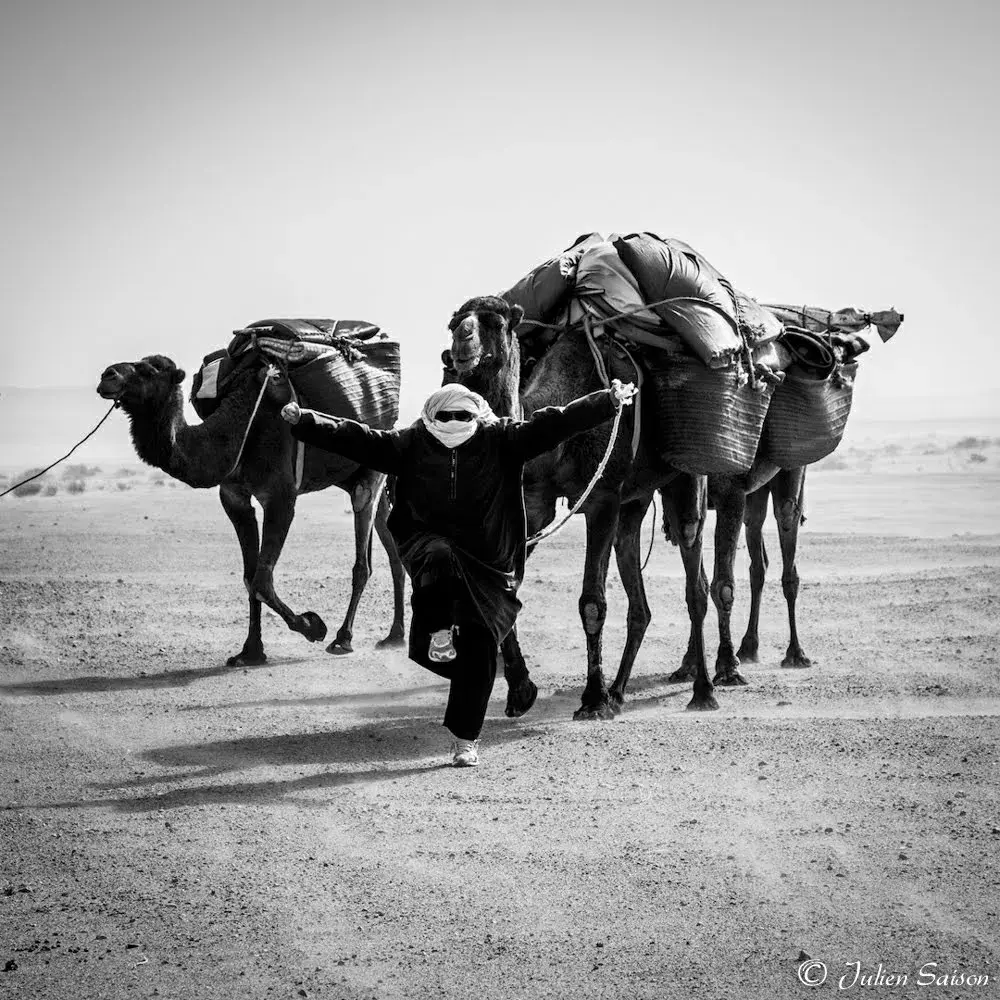
A supported walking journey from the M’hamid region where camel handlers carry agreed camp equipment while travelers move through hammada, tamarisk and dunes.
A supported walking journey from the M’hamid region where camel handlers carry agreed camp equipment while travelers move through hammada, tamarisk and dunes.
Highlights
Several hours of walking each day at a measured caravan pace
Mobile camps or named fixed camps defined in advance
A route shaped by water, weather and the group rather than a rigid performance target
Included & excluded
This is different from a sunset camel ride. Daily walking, water, shade, bedding, luggage limits, animal welfare and emergency access all require a written operational plan.
Your route
Day by day, without rushing.
Day 1
M’hamid → Ras Nkhal
Morning
Meet the guide and caravan team in M’hamid, review footwear, water, luggage and the day’s heat, then begin walking beyond the cultivated oasis edge.
Midday
Stop in shade for lunch and rest. Trekking hours are split around temperature rather than pushed through the middle of the day.
Afternoon
Continue toward Ras Nkhal across firm desert ground and scattered tamarisk.
Signature experience
Leaving the last oasis on foot and settling into the slower rhythm of a supported desert caravan.
Evening
Arrive at the bivouac area, have dinner prepared by the support team and sleep in the agreed camp format.
Driving
No road driving during the trek; walking time is approximately five hours when conditions and group ability permit.
Meals
Lunch, dinner and breakfast arrangements are confirmed for the supported trek; drinking-water provision is stated before departure.
Accommodation
Mobile desert bivouac or fixed camp as named in the proposal.
Practical note
Walkers carry only personal day items when caravan support is included. Tell us about injuries, medication or walking limitations.
Day 2
Ras Nkhal → Kriaat Jmal
Morning
Break camp after breakfast and walk through open desert where navigation depends on local knowledge rather than marked paths.
Midday
Rest beneath available tamarisk shade while the team prepares lunch.
Afternoon
Continue toward Kriaat Jmal at the pace of the group and animals, with stops for feet, water and weather.
Signature experience
Crossing the quieter spaces between dune fields, where the trek is defined as much by scale and silence as by sand.
Evening
Settle at the next bivouac, share dinner and review the following day’s conditions.
Driving
No driving; around five hours of walking is the working plan, adjusted for heat, wind and ability.
Meals
Supported trek meals as specified in the proposal.
Accommodation
Mobile bivouac in the Kriaat Jmal area.
Practical note
Long trousers, secure walking shoes, sun cover and protected electronics are important; fine sand reaches bags and devices.
Day 3
Kriaat Jmal → Bougarn
Morning
Continue across mixed hammada and sand, taking the firmer line selected by the guide.
Midday
Pause for the main rest and meal during the hottest part of the day.
Afternoon
Walk toward Bougarn as the horizon opens and the larger Chegaga dune system draws closer.
Signature experience
A full trekking day across changing desert surfaces, supported by the caravan rather than a vehicle transfer.
Evening
Camp in the Bougarn area, eat with the team and watch the night sky away from permanent lighting.
Driving
No driving; planned walking is around five hours, subject to conditions.
Meals
Breakfast, lunch and dinner according to the trek inclusion list.
Accommodation
Mobile bivouac near Bougarn.
Practical note
The guide can shorten or redirect the stage for heat, wind, fatigue or animal welfare.
Day 4
Bougarn → Erg Chegaga
Morning
Walk the final stage toward Erg Chegaga, approaching the larger dunes gradually rather than arriving by road.
Midday
Rest and eat before the last walking section, with the schedule adjusted to temperature.
Afternoon
Reach the Chegaga dune area and finish the trek at the confirmed camp or meeting point.
Signature experience
Arriving at Erg Chegaga on foot after a supported multi-day crossing from M’hamid.
Evening
Dinner and overnight at the selected Chegaga camp, or a 4×4 return only when that option is explicitly booked.
Driving
Walking stage followed by any confirmed 4×4 transfer; Chegaga to M’hamid is approximately two hours off-road when returning that way.
Meals
Meals follow the confirmed trek and camp plan.
Accommodation
Named Erg Chegaga camp or end-of-trek arrangement.
Practical note
Camel welfare takes priority over fixed riding expectations. This is primarily a walking trek; riding time is never guaranteed as a substitute for fitness.
Clear from the start
Included & excluded
Typically included
Private transport, driver-guide, selected accommodation, stated meals and activities shown in your proposal.
Usually separate
Flights, travel insurance, drinks, tips, personal purchases and entry tickets unless specifically stated.
Before you travel
Practical details for a comfortable journey.
Fitness
Share recent walking experience, foot or joint issues and heat tolerance. Training should begin before travel.
Camp format
Confirm mobile or fixed camp, sleeping setup, toilet arrangement, washing water and what the support team carries.
Daily rhythm
Walking starts in cooler hours, with rest around heat and route conditions. Distances are guidance, not a race.
Best fit
For travelers comfortable with simple conditions, limited connectivity and consecutive walking days.
Why choose this journey?
Choose it for slow immersion and supported walking, not as a more adventurous label for a normal camp night.
Route questions
What to confirm before booking
Do I ride the camel all day?
No. The program is primarily a supported walk; riding depends on the agreed plan, animal welfare and conditions.
Are there showers?
Do not assume so on a mobile trek. The exact hygiene and toilet arrangements are explained before booking.
What happens if I cannot continue?
Emergency and vehicle-access arrangements depend on the route and must be discussed for the specific group.
Continue exploring
Turn inspiration into a connected Morocco journey.
After agreeing your itinerary, a 20–30% deposit normally secures your dates and camps. Your proposal confirms the exact amount, balance and cancellation terms before payment.
Your Morocco, privately designed
Let the journey begin.
Tell us how you like to travel. We’ll turn it into a route worth remembering.