Morocco destination guide
M’hamid El Ghizlane: Morocco’s Desert Gateway
M’hamid El Ghizlane is the final oasis town on the paved Draa road and the practical starting point for Erg Lihoudi, Erg Chigaga and multi-day camel treks. It is a living southern community, not simply a transfer point.
At a glance
Why visit M’hamid El Ghizlane
M’hamid is the last town before the desert tracks.
M’hamid is where the paved Draa road reaches its final oasis settlement before the open Sahara. The town and its surrounding palm country are home, workplace and meeting point for local families; they should not be described as an empty frontier created only for desert departures.
The geography matters when planning. Erg Lihoudi is a relatively close dune area outside town, while Erg Chigaga lies much farther into the desert and normally requires around two hours by 4×4. A camp advertised simply as ‘M’hamid desert’ may be in either direction, so the exact location changes the journey considerably.
An overnight in or near M’hamid separates the long paved approach from the off-road stage. It is especially useful for families, winter arrivals and travelers beginning a supported camel trek, because water, luggage, guides and the next day’s route can be organized without racing the light.
Make the visit count
What is worth your time in M’hamid
Walk where oasis and desert meet
Explore the transition between homes, palms, cultivated plots and open ground with a local introduction. The interest lies in how people live at the edge of an advancing desert, not in treating residential lanes as scenery.
Choose the right dune experience
Use Erg Lihoudi for a shorter camp approach or continue by 4×4 to the broader Chigaga landscape. Ask for the exact camp position, travel time and bathroom arrangement before comparing offers.
Begin a supported camel trek
M’hamid is a practical base for routes through Ras Nkhal, tamarisk country and onward desert stages. Daily walking time, support vehicle or camel logistics, water, shade and sleeping arrangements should be confirmed route by route.
Add context south of Zagora
Build in time for Tamgroute or a Draa Valley stop rather than arriving after a continuous transfer. This turns M’hamid into the culmination of an oasis journey rather than an isolated camp pickup point.
Weather and timing
When M’hamid and the desert work best
October–November
Warm daylight and cooler evenings usually suit oasis walks, 4×4 travel and camel trekking. Popular dates should be planned early, while wind remains possible in any desert season.
December–February
Days can be clear and comfortable, but nights and early departures are genuinely cold. Confirm room or tent heating where relevant and pack layers beyond normal city clothing.
March–April
Temperatures rise and spring wind can bring dust or sand. Keep exposed activity flexible and let local conditions determine the safest track and timing.
May–September
Extreme heat makes ordinary sightseeing and long exposed activity unsuitable. Any summer movement requires conservative local advice; a standard winter itinerary should not simply be shifted to hotter hours.
Build a realistic route
How M’hamid fits into a southern route
Route fit
Route fit
M’hamid works best after a staged journey through Ouarzazate, Agdz, Zagora and the Draa Valley. Stay before or after Chigaga, use it as the start of a multi-day camel trek, or choose nearby Erg Lihoudi when available time does not support the deeper off-road journey. If returning through Lake Iriki and Foum Zguid, the route becomes a loop and does not pass back through M’hamid.
Accommodation
Accommodation
First decide whether you want to sleep in town, beside the palm groves, at Erg Lihoudi or farther into the Sahara. Guesthouses in and near M’hamid simplify arrival and departure; camps exchange that convenience for a dune setting. Confirm the map location, vehicle access, bed type, shared or private bathroom, electricity, winter bedding, included meals and how luggage reaches the room or tent.
Travel well
What to confirm before leaving the paved road
- Buy water and essential personal items before leaving the paved road.
- Ask for the precise camp location rather than relying on ‘near M’hamid.’
- Dress and photograph respectfully in residential and agricultural areas.
- Keep departure times flexible when wind, heat or sand affects the track.
- For camel treks, confirm walking hours, shade, water, support and sleeping arrangements in writing.
Continue planning
Routes that start from M’hamid
Journeys that visit
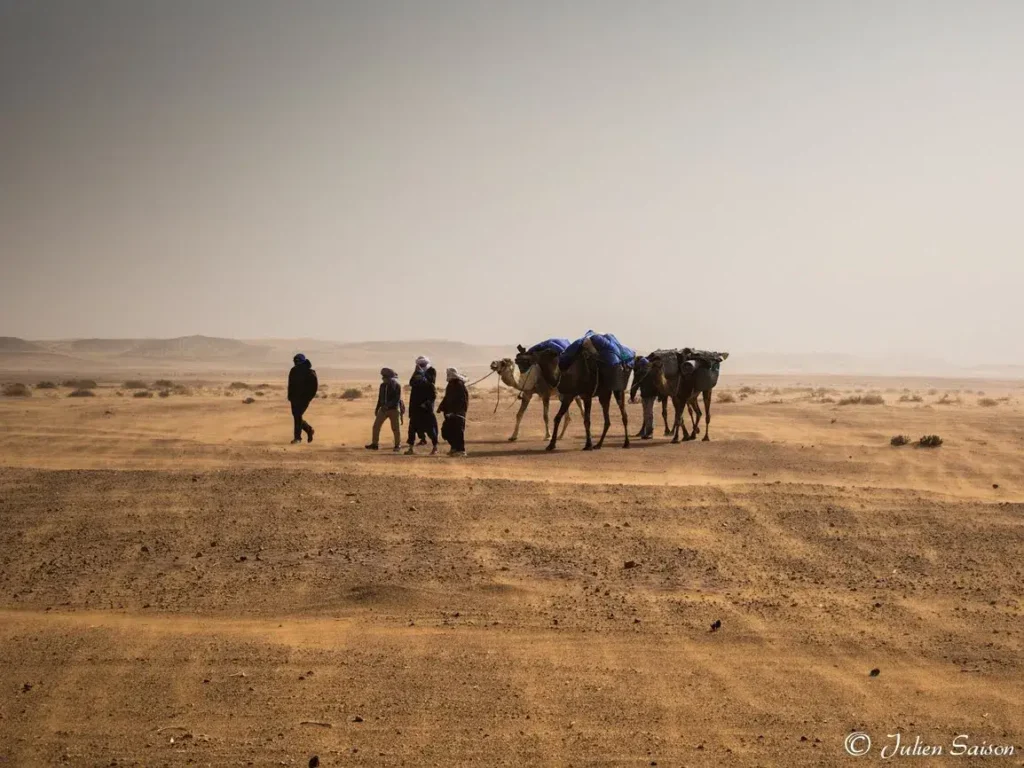
Adventure
M’hamid · Erg Chigaga
Walk with a small caravan through tamarisk shade, open hammada and rolling dunes, camping far from the road.
4 days · Guided trek · from €650
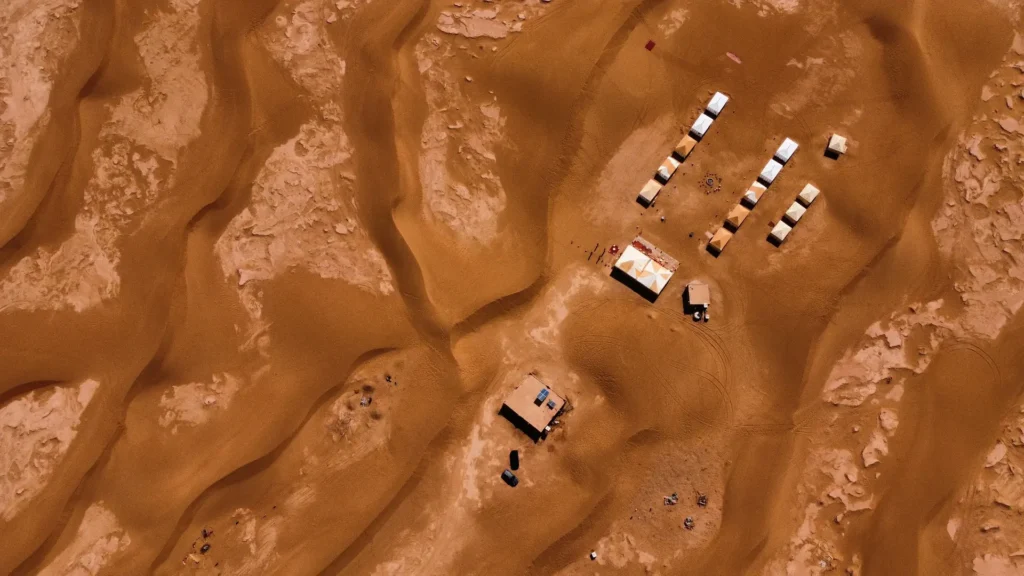
Short escape
M’hamid · Erg Lihoudi
A beautifully paced introduction to the Sahara with camel trekking, campfire music and dune silence.
3 days · From Marrakech · from €450
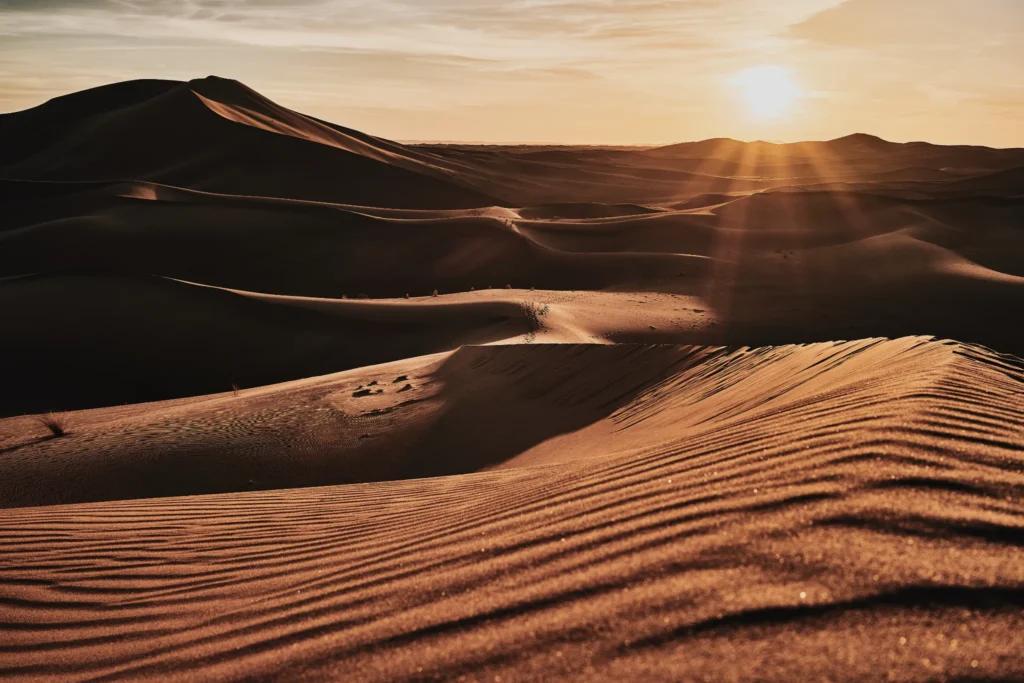
Desert
Marrakech · Erg Chigaga
Cross the High Atlas, follow the Draa Valley and spend two unhurried nights beside Morocco’s wildest dunes.
4 days · Private 4×4 · from €595
Relevant experiences
Desert ritual
Move with the quiet rhythm of the caravan as evening light crosses the dunes.
Private · 1–3 hours
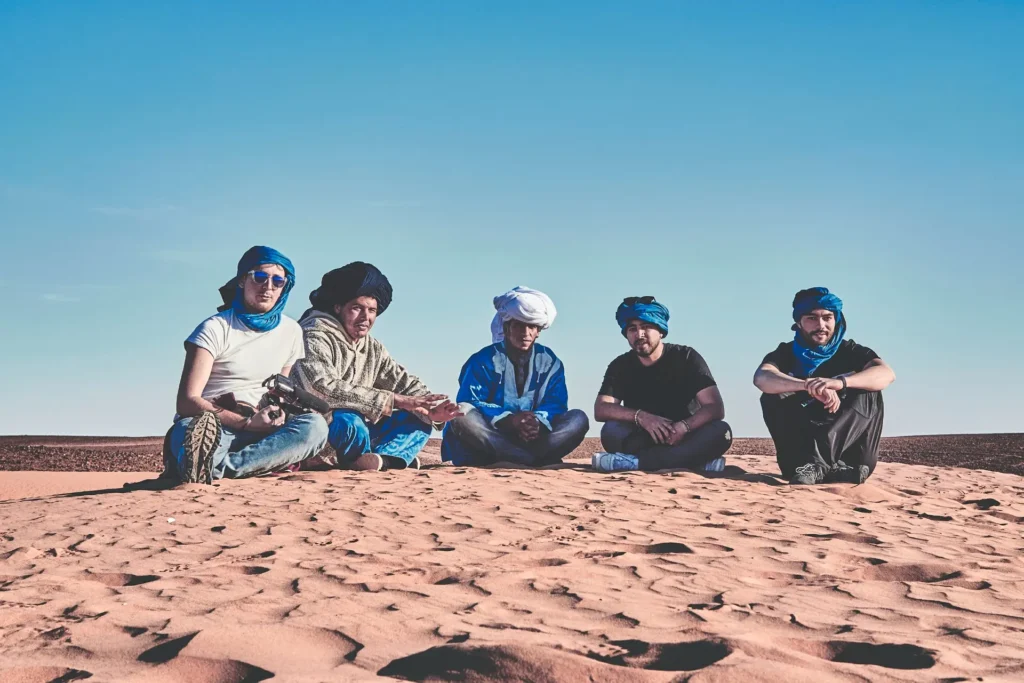
Meet & learn
Share tea, stories and daily traditions with families connected to this land.
Community-led
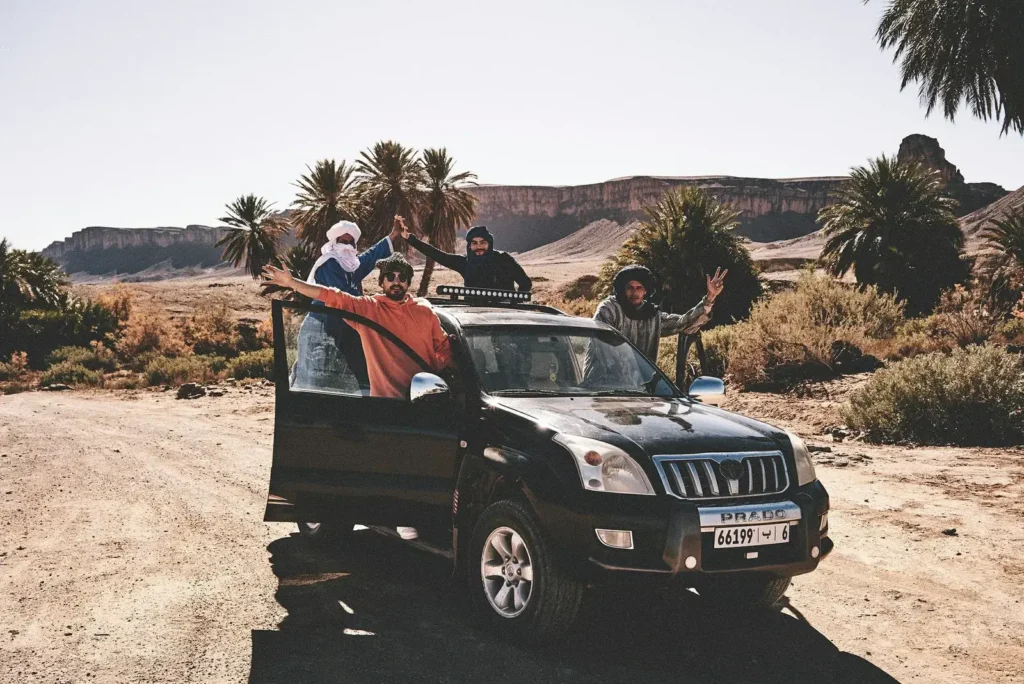
Beyond the road
Trace dry lakes and forgotten tracks with a local driver who reads the desert.
Half or full day
Useful planning guides
Destination questions
Questions about visiting M’hamid
Is M’hamid itself in the dunes?
M’hamid sits at the oasis and desert edge. Dune areas and camps are outside town; Erg Lihoudi is closer, while Erg Chigaga requires a much longer off-road transfer.
How long should I stay in M’hamid?
One night is useful for a rested arrival or departure. Two nights suit travelers who want local context, a nearby dune outing or a slower transition before a deeper Sahara journey.
Can I drive from M’hamid to Erg Chigaga in a normal car?
No. The Chigaga approach is off-road and requires a suitable 4×4 with a driver who understands current track and weather conditions.
Is M’hamid only useful for Chigaga?
No. It is also a base for Erg Lihoudi, supported camel treks, oasis stays and journeys that focus on the living Draa–Sahara transition.
Planning from M’hamid?
Choose the desert area before choosing the camp.
Tell us your dates and available time. We’ll explain the difference between M’hamid, Erg Lihoudi and Erg Chigaga.